
Clinical EFT Tapping is an amazing tool that can help you release emotional and physical tension, and rewrite neural pathways around unwanted thoughts, emotions and (traumatic) memories.
Over 300 clinical trials show that EFT is effective for anxiety, depression, pain, PTSD, phobias, and other conditions.
EFT is an integrative mind–body approach. The technique uses acupressure and combines somatic and nervous system interventions with gentle exposure and memory reconsolidation.

I support people with chronic conditions*, including (but not limited to): chronic pain, anxiety, depression, PTSD, complex trauma (cPTSD), fibromyalgia, burnout, auto-immune conditions, chronic fatigue and TBI to move out of survival mode so they can feel in charge of their own life again.
What all these conditions have in common is that they have you experience a lot of stress and negative emotions.
Clinical EFT helps to calm the stress responses in your body as well as to release the negative emotions that you experience around your condition(s). When you feel better, there may be more space for physical healing if this is physically possible. EFT has been shown to be effective in reducing the experience of physical pain.
“Maryse is a great practitioner and provides such a peaceful, safe, supportive environment for EFT work. She is intelligent, patient, warm, funny and I’ve enjoyed working with her so much! I would recommend everyone to work with her…she’s helping ME change MY life! What a wonderful gift!” Shilah, Florida, USA
Special Event (olnine):
Tapping Circle on Frustration
Date: Thursday 30 July
Time: 9am AEST or 7pm AEST
Clinical EFT is a fully client-lead modality, so I will meet you exactly where you are and we will always work at your pace. Everything you feel is taken seriously, and as you release your stress and emotions, shifts in perspective occur naturally in your own mind.
If you wonder if Clinical EFT is the right thing for you, feel free to contact me with any questions or book a complimentary Discovery Session.
SPECIAL EVENT (ONLINE):
Tapping Circle ‘Frustration’
Date: Thursday 30 July
Time: 9am AEST or 7pm AEST
Self Help Tapping versus Working with a Clinical EFT Practitioner
Tapping is a great self help technique and I encourage you to use it. (Scroll down below to learn how to use basic tapping as a self help tool). You can use it to calm yourself down in a moment that you are upset. I like to call this ’emergency tapping’. You can also use it as a daily practice to tap on anything that bothers you and this way you are training your nervous system to become more resilient in the face of stressors.
There are a number of reasons however why tapping by yourself may not give you the lasting results you had hoped for. This does not mean that tapping does not work for you!
When you cannot get the results by yourself or when the problem is too overwhelming for you to handle by yourself, a Clinical EFT Practitioner is invaluable. Most people can get benefits from tapping by themselves, but as a certified practitioner I can guide you safely and gently in the right direction as you explore the origins and release the charge of difficult emotions, memories and traumas, big and small.
As a practitioner I hold a space for you to express whatever needs to be expressed, without judgement, and help you build the capacity of your nervous system so that you can feel more confident and resilient in the face of what life throws at you. My work is deeply trauma-informed and I am always engaging with learning more on this topic to make sure I hold yours safely.
With a practitioner, you can use tapping to:
- Help you release the emotional impact of bigger issues like trauma, fears and phobias, pain, anxiety and more.
- You can work to rewire patterns like people pleasing, procrastination, boundary setting and more.
- And you can work on repatterning limiting beliefs such as “I’m not good enough”, “I’m alone”, “I’m invisible” and more.
As a Certified Clinical EFT Practitioner, I have been trained in all 48 scientifically proven techniques to help you get to the root of your problem to help you create the emotional freedom you are looking for!💚
“It’s been wonderful getting to work with Maryse and uncover where my inner child has needed validation and support. Now I am feeling much more empowered and in collaboration with my inner child. All thanks to Maryse’s guidance and her clear knowledge on Clinical EFT processes! I am also looking forward to her tapping circle as well. Her inspiration being nature helps me to feel very grounded and I highly recommend Maryse!” Mary, New Mexico, USA.


What can I work on with Clinical EFT?
You can work with Clinical EFT on anything that bothers you! Big or small, it is great to feel the relief after tapping through a negative experience. Bigger issues will generally take more sessions than smaller issues, but not always! Clinical EFT can also assist you in reaching your goals or enhancing your performance.
“Thinking about the letter has significantly changed. The attached emotions are gone. Thinking about speechlessness, this is no longer in me. It is just a letter, I am fully outside of the topic. That is gorgeous.” Bettina (after working on a disturbing memory).
You can use Clinical EFT for*:
- Anxiety
- A Disturbing Memory
- Depression
- Trauma, PTSD & Complex Trauma (e.g. accidents, injury or illness, early childhood trauma)
- Fears & Phobias (e.g. fear of spiders or snakes, fear of dentist, fear of public speaking, claustrophobia)
- Cravings & Bad Habits (e.g. food cravings, people pleasing, procrastination, excessive scrolling)
- Limiting Beliefs (e.g. “I’m not good enough”, “I’m a failure” “I’m not worthy”)
- Physical Issues (e.g. pain, chronic issues)
- High Sensitivity (e.g. loud noises and bright lights)
- Goals (e.g. achievements, lifestyle improvements)
- Enhance Performance (e.g. career, sport, study)
- and more … feel free to ask! 💚
“I recommend working with Maryse on any issue with which you need help. She is kind and patient during sessions, especially when I couldn’t remember anything related to the issue that we were working on. She gave me “permission” not to remember and, of course, once the pressure was off, I remembered many details I thought were lost. Her sense of humor is a big plus. Reaching out to Maryse was a great decision for me and I’m sure it will be a great decision for you.” Becky, North Carolina, USA.
“I had a very positive experience working with Maryse. Her style is supportive, she listens, and helps her clients feel completely at ease. Maryse has a very calm presence and provides gentle guidance. For the stage of Maryse’s training, she facilitates emotional patterns to get to the bottom of the problem to an impressive degree. We had three sessions, and in each session, I noticed helpful shifts in my emotions. I always finished the sessions feeling clearer and lighter than before. Maryse has compassion and integrity, and I would wholeheartedly recommend her to anyone seeking meaningful emotional healing.” Pip, Queensland, Australia.
Are you ready for change? Book a complimentary Discovery Session:
Tapping Circles: Clinical EFT Tapping in Groups
Tapping can also be done in groups. Tapping together can be a powerful experience and give you lots of benefits.
Join my online Community Tapping Circles! It is free!
You can also book me for a custom Tapping Circle – see my Events, Talks and Workshops page. A Tapping Circle can be a wonderful way to introduce a group to the technique and work on a specific topic or theme (e.g. overwhelm, boundary setting, ecogrief… just ask!💚).
Basic Tapping as a Self Help Tool
Technically, it is quite simple. So simple, that it is a brilliant self help tool and I am happy to share it here with you.
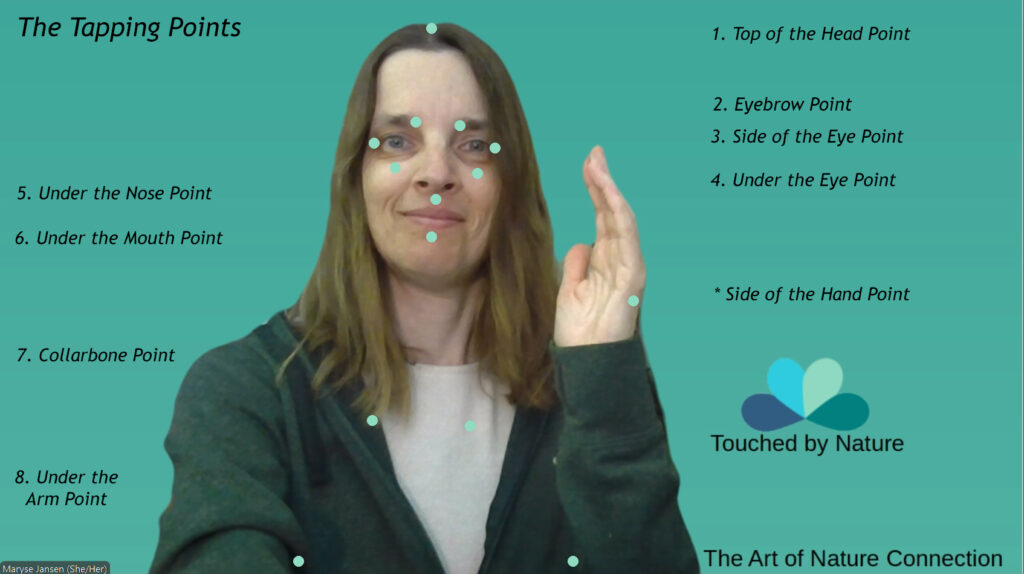
When you tap, you literally physically tap on certain acupressure points with your fingertips. The more accurately you target the specific points, the better the result will be so below I will describe exactly where you can find the points as shown in the image above.
- Top of the Head Point: this point sits literally at the top of your head, in the centre, right between the tops of your ears.
- Eyebrow Point: you can find this point where your eyebrow meets the bridge of your nose.
- Side of the Eye Point: obviously on the side of your eye, but quite close to the outer corner of your eye – on the orbital bone.
- Under the Eye Point: below your pupil, on the cheekbone.
- Under the Nose Point: just underneath your nose in the little crease that runs down from your nose to your upper lip (it’s called the philtrum). You have to pull in your upper lip a bit to reach it well.
- Under the Mouth Point: going straight down past your lower lip in the dent between your lower lip and your chin. Pull in your lower lip a bit to be able to reach it well.
- Collarbone Point: find the point where your collarbone meets your breastbone, then move a little bit down and a little bit out (about 2-3cm) until you feel a bit of a dent – there’s the point!
- Under the Arm Point: about 10cm under your armpit, on the side of your body. For women: this is where the bra strap sits. Lift your arm for easy access with your opposite hand.
There is one point left: the Side of the Hand Point. You can find it on the side of your hand, just below the joint between your hand and your pinky finger. This point is named separately because it has a special function. It is used to get started and set up the issue that you are going to tap on. After that you will go through points 1-8 in order while reminding yourself of the issue.
How to do a Tapping Sequence:
1. Determine a problem that you want to work on. Check in with your emotional intensity around this problem. You can give it a score from 0-10, where 0 is no emotional intensity and 10 is the highest emotional intensity. This is called your SUD score (Subjective Unit of Distress). Note down your number. I strongly recommend you start with something of a relatively low intensity if you are new to tapping!
2. Tap on the Side of the Hand Point with the fingertips from the opposite hand while stating: “Even though I have this ‘problem’, I accept myself and how I feel’. You fill in the words that describe your own problem. Repeat this 3 times while you keep tapping.
3. Then tap through the 8 other points in order, while reminding yourself of ‘this problem‘. Tap gently with your fingertips, about 7 times on each point. Some points occur twice, one on the left side and one on the right side of your body. You can tap either side, or both, whatever feels good to you.
4. Stop tapping. Take a deep breath. Now check in with your problem and see if your SUD score has changed.
5. In simple terms what happens is that, while you expose yourself to the problem and the emotions you feel around it, you are tapping to send calming messages to your nervous system. Therefore it is likely that your SUD score will go down.
That’s it! This is how you can use tapping as a self help tool! I hope it will bring you great benefits! 💚
➡️ If your score goes up, that’s okay, this can happen sometimes when we haven’t allowed ourselves to feel a certain thing – just keep tapping until it comes down again. If you don’t feel a difference or if you can’t get it to come down, please reach out. As a practitioner I can help you get the results you are looking for! 💚
The Science
A Systemic Review (Church et al., 2022) of Clinical EFT as an evidence-based practice for the treatment of psychological and physiological conditions in 2022 found “EFT treatment to be effective for:
- (a) psychological conditions such as anxiety, depression, phobias, and posttraumatic stress disorder (PTSD);
- (b) physiological issues such as pain, insomnia, and autoimmune conditions;
- (c) professional and sports performance; and
- (d) biological markers of stress.
Meta-analyses evaluating the effect of EFT treatment have found it to be ‘moderate’ to ‘large.’ Successful independent replication studies have been carried out for anxiety, depression, PTSD, phobias, sports performance, and cortisol levels” (Church et al., 2022, p. 1).
“The study concludes that comparatively few treatment sessions are required, treatment is effective whether delivered in person or virtually, and symptom improvements persist over time. Treatment is associated with measurable biological effects in the dimensions of gene expression, brain synchrony, hormonal synthesis, and a wide range of biomarkers. Clinical EFT is a stable and mature method with an extensive evidence base. Its use in primary care settings as a safe, rapid, reliable, and effective treatment for both psychological and medical diagnoses continues to grow” (Church et al., 2022, p. 2).
For a comprehensive overview of the science behind Clinical EFT, visit the EFT Research Bibliography at EFTUniverse.
* See Terms & Conditions for Medical Disclaimer
References:
Church, D., Stapleton, P., Vasudevan, A., & O’Keefe, T. (2022). Clinical EFT as an evidence-based practice for the treatment of psychological and physiological conditions: A systematic review. Frontiers in psychology, 13, 951451. https://doi.org/10.3389/fpsyg.2022.951451
